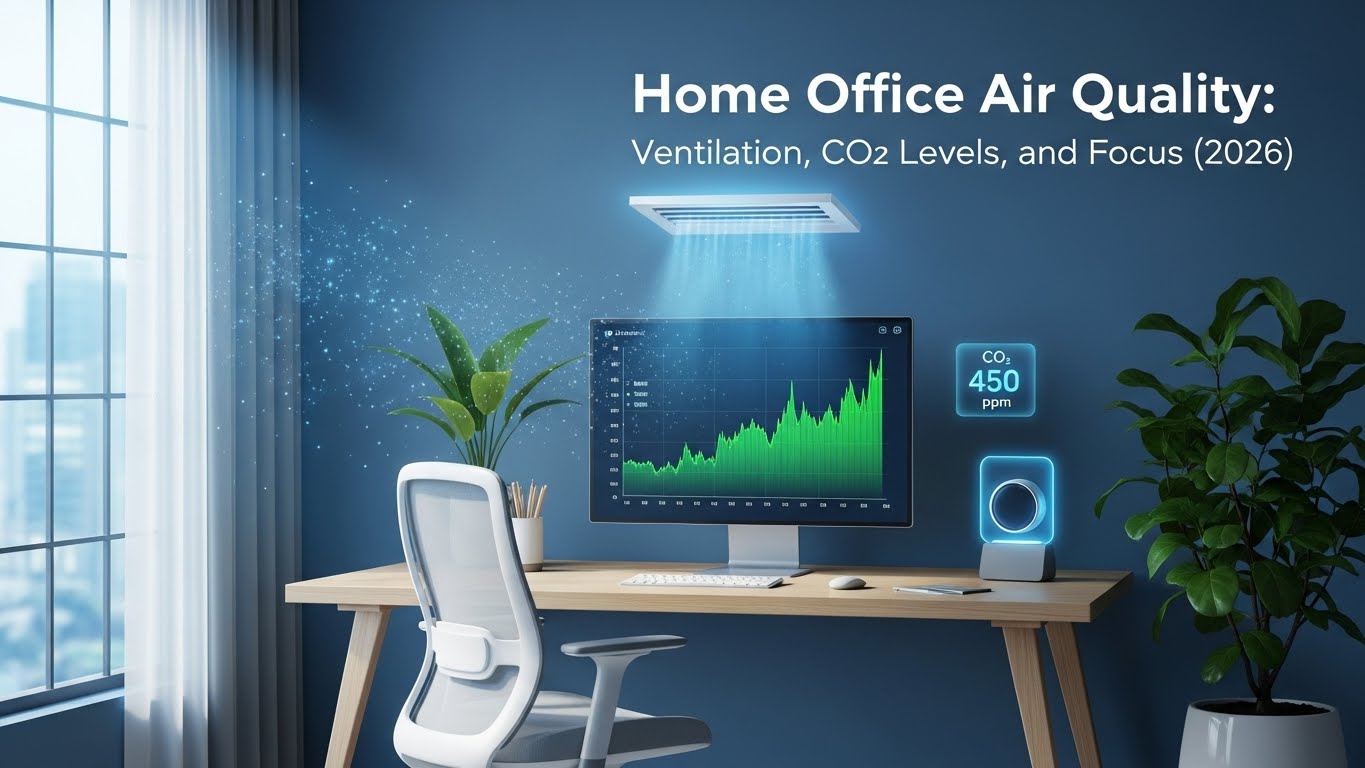
Home Office Air Quality: Ventilation, CO₂ Levels, and Focus (2026)
How does CO₂ and air quality affect your home office focus?
In a closed home office, CO₂ rises quietly and your brain pays the price first:
slower decisions, heavier eyelids, and “why am I rereading this sentence?” moments.
The fastest fix isn’t new gear—it’s air exchange.
- CO₂ target: aim for < 800 ppm (watch how fast it climbs in small rooms)
- Ventilation: 3–5 minutes of full opening every 60–90 minutes
- Cross-draft: two openings (even briefly) flush air far faster than one
- AC reality: cool air ≠ fresh air (most AC recirculates; CO₂ still accumulates)
- Humidity: keep roughly 40–60% to reduce dry eyes + throat fatigue
If these show up repeatedly (especially at the same time each day), check ventilation before blaming motivation:
- Heavy eyelids, constant yawning, or sudden “brain fog”
- Midday headaches that fade after stepping outside
- Dry throat / itchy eyes even when lighting feels fine
- Noticeable drop in complex problem-solving speed
Last Updated: January 2, 2026 |
Expert Review: WorkNest Workspace Lab |
Author: WorkNest Studio Editorial Team
Home office air quality is one of those “invisible productivity” problems.
You can buy an ergonomic chair and a crisp monitor—then lose hours because your brain is working in slow motion.
The sneaky culprit is often carbon dioxide (CO₂) buildup plus stagnant airflow.
What makes it tricky: you might not feel “sleepy.”
You just feel slightly less sharp, more distractible, and weirdly impatient.
That’s why a simple ventilation rhythm can outperform a lot of expensive upgrades.
Table of Contents
- 1) CO₂ Levels and Cognitive Performance
- 2) Ventilation Basics: The Air Exchange Method
- 3) Why Small Rooms Hit the Wall Faster
- 4) Airflow vs Temperature: The AC Illusion
- 5) Humidity: The “Dry Eyes = Low Focus” Connection
- 6) Good vs Poor Air Quality Signals
- 7) A Simple Daily Protocol (No Overthinking)
- 8) FAQ
- 9) Internal Links
- 10) Sources & References
- 11) Professional Disclaimer
1) CO₂ Levels and Cognitive Performance
CO₂ isn’t “poison” at typical indoor levels, but it does correlate with measurable changes in how well we think.
Many studies report decision-making quality and strategic performance dropping as indoor CO₂ rises,
especially once it pushes past the ~1,000 ppm range.
In a home office—especially a bedroom setup—CO₂ can climb into that zone within 60–90 minutes if windows stay closed.
The result is familiar: rereading lines, slower problem-solving, and a strong urge to “take a break” that doesn’t actually refresh you.
800–1,000 ppm: some people notice mild drift / heavier eyes
> 1,000 ppm: brain fog becomes more common (especially in small rooms)
2) Ventilation Basics: The Air Exchange Method
Effective ventilation doesn’t mean leaving a window cracked all day.
What matters is how quickly you replace stale air with fresh air—your air exchange.
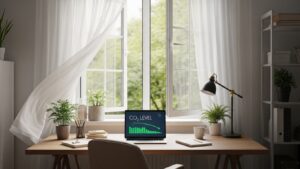
- Short-burst ventilation: open windows fully for 3–5 minutes every 60–90 minutes
- Cross-ventilation: two openings (opposite points) create pressure difference and flush air much faster
- VOC dilution: air exchange also helps reduce VOCs from furniture, carpets, printers, and cleaners
3) Why Small Rooms Hit the Wall Faster
Small rooms have less air volume—so your exhaled CO₂ changes the room faster.
If your desk is in a bedroom, a converted storage room, or a tight studio corner,
you can be “fine” early, then suddenly feel like your brain got wrapped in cotton.
A simple pattern to watch:
if your focus drops at a similar time every day (even after good sleep),
treat that as a ventilation clue—not a personality flaw.
4) Airflow vs Temperature: The AC Illusion
A room can feel physically comfortable and still be mentally draining.
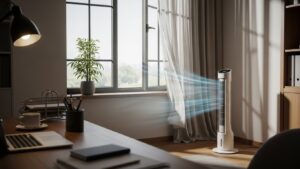
That’s because most residential AC systems primarily recirculate indoor air to control temperature,
but don’t actually remove CO₂ or bring in new oxygen the way ventilation does.
So yes—cool air helps comfort. But fresh air is what protects focus.
If you want to “feel awake,” airflow + exchange is the combo.
5) Humidity: The “Dry Eyes = Low Focus” Connection
Humidity doesn’t get the same hype as CO₂, but it affects attention in a very human way:
dry eyes, scratchy throat, and shallow breathing make you fidgety—then concentration breaks earlier.
- 40–60% humidity is a common comfort band for many workspaces
- If you use heating in winter, indoor air often dries out faster than you realize
- If humidity is high, ventilation helps reduce that “heavy air” feeling
6) Good vs Poor Air Quality Signals
| Signal | Poor Air Quality (High CO₂ / Stagnant) | Healthy Air Quality |
|---|---|---|
| Mental clarity | Brain fog, slower thinking | Stable focus, quicker decisions |
| Energy | Yawning, restlessness | Even energy across long sessions |
| Work rhythm | Breaks feel “necessary” but don’t refresh | Longer deep-work blocks |
7) A Simple Daily Protocol (No Overthinking)
2) Set a timer: every 60–90 minutes do another 3–5 minutes
3) During calls: prefer cross-vent for speed (two openings)
4) If fatigue hits: ventilate first, then reassess (before coffee, before doom-scrolling)
5) If air feels dry: aim for 40–60% humidity and keep ventilation short & effective
8) FAQ
Q1) Will an air purifier remove CO₂?
A) No. HEPA filters handle particles; carbon filters can reduce odors/VOCs. CO₂ needs ventilation.
Q2) Are plants effective CO₂ scrubbers?
A) Plants are great for comfort, but meaningful CO₂ reduction during work hours would require an unrealistic number of large plants.
Q3) Do I need a CO₂ monitor?
A) Not required, but it can be eye-opening—especially in small rooms. If you buy one, look for NDIR sensing.
Q4) How often should I ventilate?
A) Every 60–90 minutes is a practical baseline. If your room is tiny or you share it with another person, you may need it more often.
Internal Links
Work From Home Noise Reduction: Apartment-Friendly Setup Guide
The Ultimate Ergonomic Home Office Setup Guide
Monitor Distance and Eye Level Guide
Sources & References
NIOSH – Indoor Environmental Quality and Worker Health
NIH – The Relationship Between CO₂ and Cognitive Function
UK HSE – Workplace Ventilation and Air Exchange Guidance
This article is for informational purposes only and does not replace medical or environmental consulting.
If you experience persistent fatigue, headaches, breathing discomfort, or symptoms that worsen, consult a qualified clinician.
For building-specific issues, consider advice from an HVAC or indoor air quality professional.
Update Log:
– Jan 2, 2026: Consolidated CO₂ thresholds + added small-room section + clarified AC vs ventilation + converted sources to one-line format.

I’m not a medical professional, ergonomist, or workplace specialist.WorkNest exists to help everyday people build more comfortable, practical home office environments through clear explanations, visual guides, and common-sense adjustments.
Articles on this site are written from a non-expert perspective, focusing on real-world use, everyday discomforts, and widely accepted setup principles rather than clinical or professional advice.